Integrity
From the company’s inception, integrity has been at the heart of the way we conduct business. We lead by communicating openly and are fully accountable for our actions.


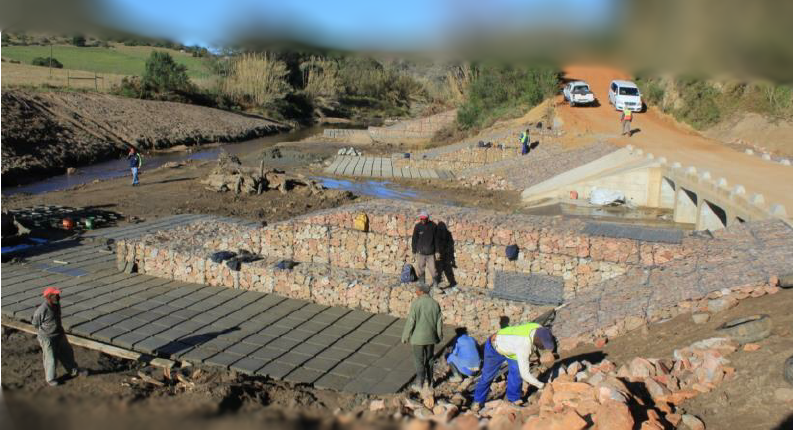
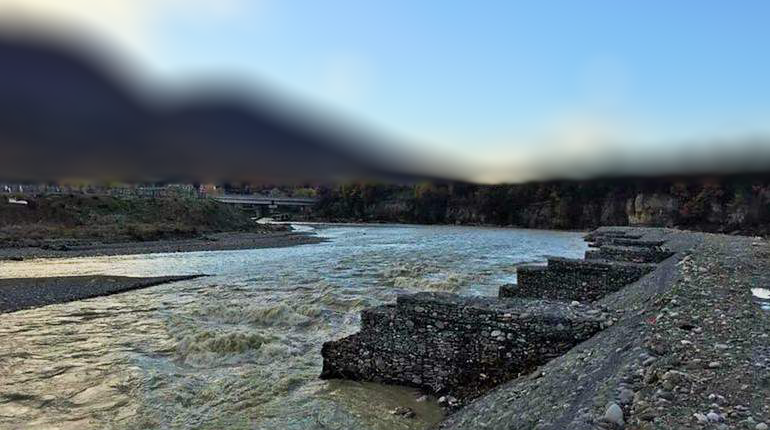

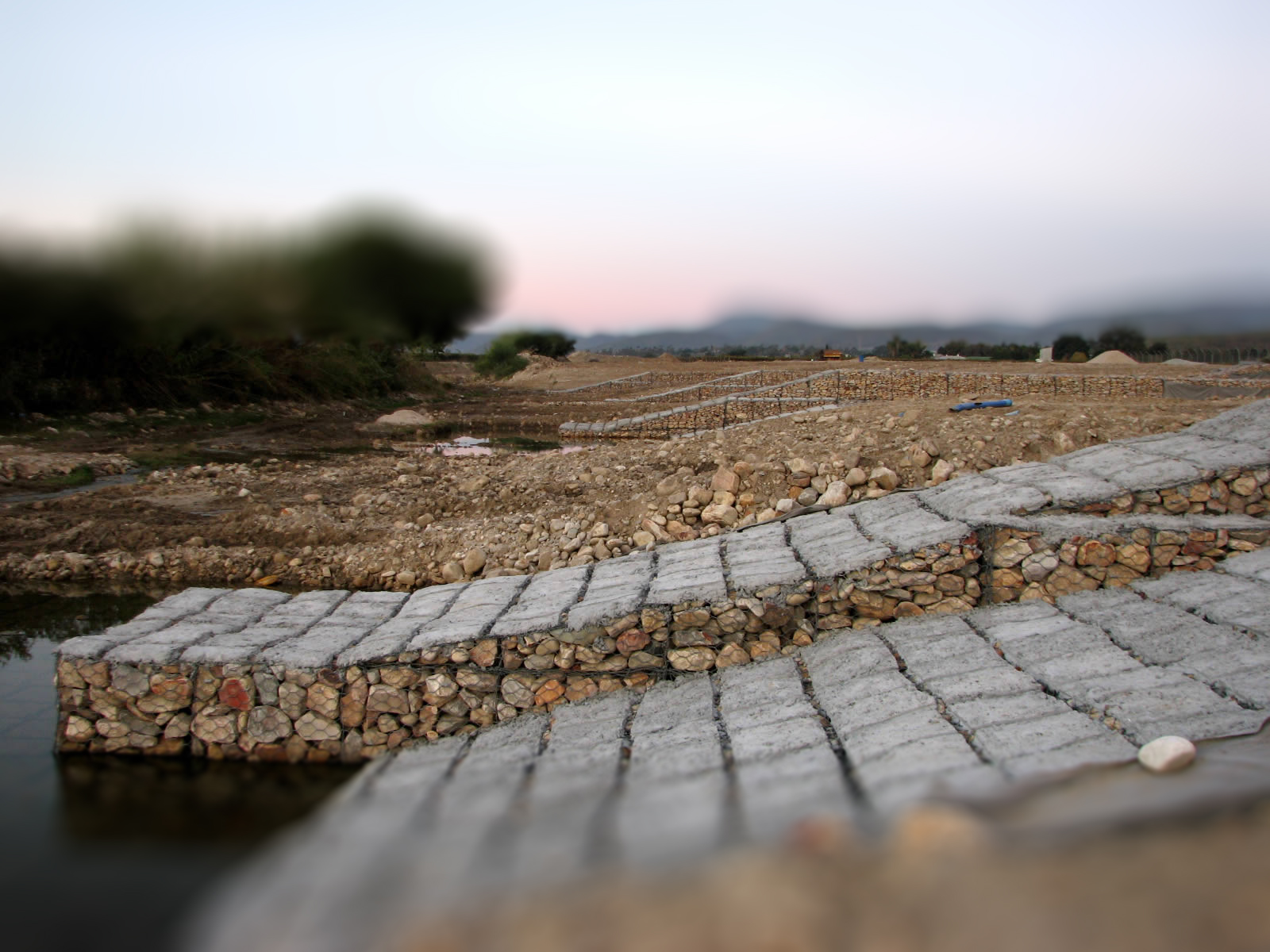

Dson Industries offer design and install for constructing Gabion Groynes walls in industrial, commercial and residential locations.
Photos of free standing walls that you may want to use as a guide for your project …
The calculations are done based on the soil report which informs us about the soil density , internal friction angle , bearing pressures , soil type , cohesion , … of the construction site.
We can help you with the design of your project. Mainly the design is carried out using a dimensioned sketch , drawing or plan which we use as a base to determine the quantities. Our designs included :
Engineering Specifications for Structural Adequate Stability
Dson Industries offer design and install for constructing Gabion Groynes walls in industrial, commercial and residential locations. Photos of Gabion Groynes that you may want to use as a guide for your project …
The calculations are done based on the soil report which informs us about the soil density , internal friction angle , bearing pressures , soil type , cohesion , … of the construction site. We can help you with the design of your project. Mainly the design is carried out using a dimensioned sketch , drawing or plan which we use as a base to determine the quantities. Our designs included :
River Groynes
Groynes are structures that extend from the river bank out into the water course. Their purpose is to divert the flow away from the river bank to prevent its erosion. A series of groynes along a river bank will encourage deposition of bed material between the groynes, raising the bed level adjacent to the river bank.
At the head of the groyne, the bed scours which results in deepening of the river beyond the limit of the groyne.
Stub or short groynes are often constructed to improve fish habitat in a river as deep pools are formed at the head of the groyne.
The spacing of the groynes to achieve the desired result is dependant on the river regime. Where the bed is very stable, the effect of deepening the main channel may be limited.
A scour protection apron is required around the groyne so that the scour does not undermine the groyne itself.
Coastal Groynes
The purpose of sea groynes is to prevent erosion of the foreshore by causing deposition of beach material between the groynes. The groynes, as with river groynes, require an apron protection to prevent scour undermining the groyne itself.
The extent of the mattress protection should be a minimum of two metres around the head of the groyne and three metres back from the head of the groyne as this is where maximum scour will occur.
Normally gabions are not recommended in a regular wave zone, but in the case of coastal groynes this will occur. The type of gabion to be used for coastal gabions must always be the PVC coated flexible woven mesh type. This is because the groyne may be distorted and requires the flexible mesh for the unit to maintain its integrity. It is very important that the units are well packed and constructed otherwise the gabion infill could abrade the protective PVC coating.
In the long term as the beach replenishment is established, it may require the groyne to be increased in height. This can be achieved by adding another course of gabions. A classic example of a very successful sea groyning scheme is at Hunstanton in Norfolk. The use of sea groynes should be limited to sandy beaches. Shingle or rocky beaches will result in abrasion of the mesh coatings.
Groynes and guide bunds are specifically designed and located within a watercourse to divert the flow away from the banks reducing hydraulic erosion damage.
They are suitable when the river is wide enough and when the banks can be modified.
Groyne spacing:
The intensity and location of siltation depends on the ratio of the of the groyne spacing relative to its length. Our technical teams can support you with your hydraulic works problems.
DESIGNS IN 2018-MARCH2020
Tons of bulk Earth Works
Walls Installed
INSTALLATION PROJECTS
Tons of rocks in Gabions Applications
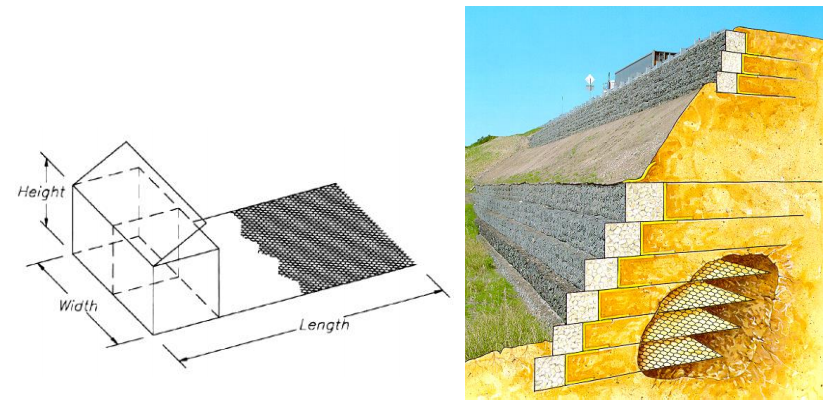 Terramesh is a versatile, modular system for reinforced slope systems and mechanically stabilised earth walls that can be a more cost effective solution than the mass gravity Gabion wall because of the speed of installation and reduced rock fill requirements
Maccaferri Terramesh are pre-assembled units of double twisted wire mesh. The facing section of the unit is formed by connecting a back panel and diaphragms to the main fascia unit. They can be used individually or combined with Geogrid or Tensar Grid for reinforcement and soil stabilisation. They are used in a wide range of applications including slip repair work and steep slope construction in both residential and road infrastructure projects.
Dson Industries offer design and install for Gabion Terramesh Walls Below Are Example Photos Of Photos of Typical Gabion Terramesh Wall that you may want to use as a guide for your project .
We can help you with the design of your project. Mainly the design is carried out using a dimensioned sketch , drawing or plan which we use as a base to determine the quantities. Our designs included :
Engineering Specifications for Structural Adequate Stability
Terramesh is a versatile, modular system for reinforced slope systems and mechanically stabilised earth walls that can be a more cost effective solution than the mass gravity Gabion wall because of the speed of installation and reduced rock fill requirements
Maccaferri Terramesh are pre-assembled units of double twisted wire mesh. The facing section of the unit is formed by connecting a back panel and diaphragms to the main fascia unit. They can be used individually or combined with Geogrid or Tensar Grid for reinforcement and soil stabilisation. They are used in a wide range of applications including slip repair work and steep slope construction in both residential and road infrastructure projects.

 Gabion cascades are used on very steep gradients to dissipate energy. The cascades are a series of steps normally 0.5m or 1.0m high with side gabion walls to contain the flow.
If there is a heavy bed load then the steps of the cascade or crest of the weir can be protected with concrete to prevent damage to the mesh.
It is recommended to use welded mesh gabions for the structures with a mattress or gabion protection down stream to prevent downward erosion due to the turbulent flow conditions. The depth of the protection should be 0.5m minimum for sufficient length until the turbulent conditions subside. This will be dependent on the flow conditions.
In very high flow rates over weirs, it may be necessary to form a stilling pond with a counter weir to further reduce the energy.
The selection of rock or stone fill is very important as the performance of gabion structures are dependant not only upon the type of unit but also the infill. An angular gabion fill is recommended.
Weirs
Weirs are designed as retaining walls and can have a rectangular or trapezoidal opening set into the top of the structure to control the water flow control in flood conditions, to reduce erosion or where their is a steep gradient used to dissipate energy.
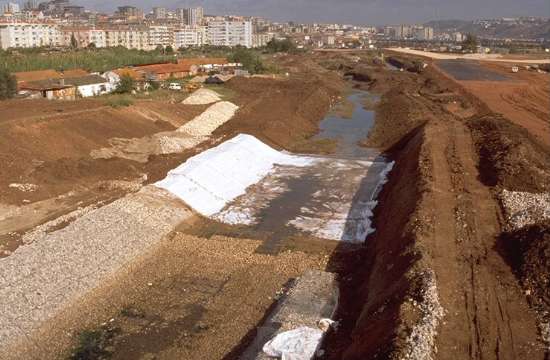 Scour protection
As with all structures used in water courses or as coastal protection schemes, a mattress toe protection or gabion toe is required to prevent under scour.
Stepped revetments are used to protect embankments against erosion where they are steeper than 45 degrees.
It is important that the design caters for potential scour. This can be achieved in two ways:
Specification
The required gabion specification is dependant on the water quality. PVC coated gabions should be specified for brackish water, saline water or where the PH is outside the range of 7 to 10, otherwise Galfan coated gabions can be used.
Ideally for river works a PVC coated 2.7mm wire or a Galfan coated 3mm wire is best as the units can accommodate movement or settlement.
Gabions used as retaining structures along water courses or as headwalls require designing in such a way as to resist the soil and external forces.
Aesthetics
If the visual appearance is important, a heavier facing mesh can be used: 3.8mm PVC coated wire or Galfan coated 4.0mm wire, respectively.
Where there is the potential for impact from river debris, it is also recommended to have a heavier mesh face.

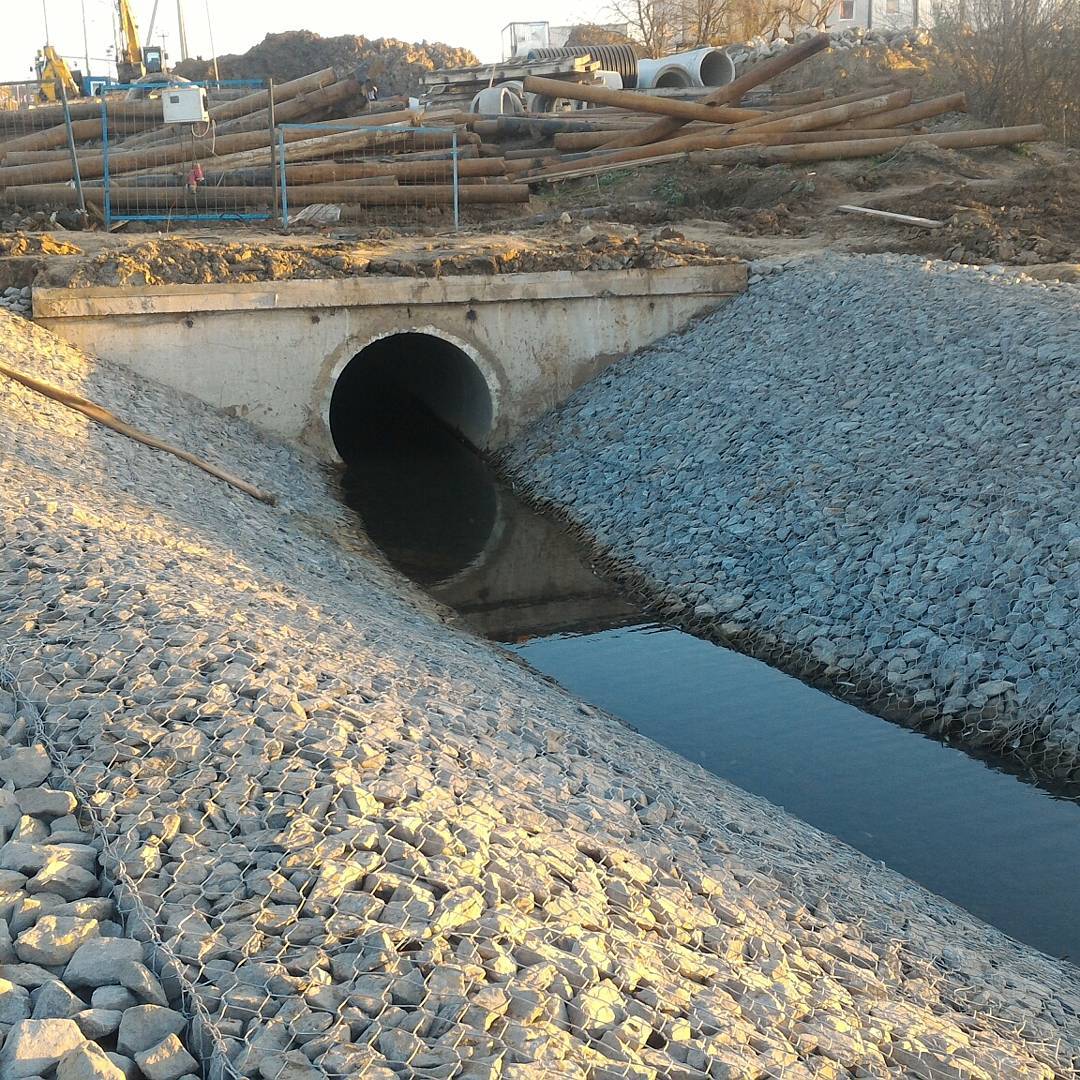 The protection required is generally a mattress laid to the bed as an apron and should extend sufficient distance upstream and downstream in the water course and also extend out into the stream. The mattress must be laid on a geotextile separator.
Outfall structures can be constructed from gabions, designed as a retaining wall having the discharge or inlet pipe pass through the retaining wall.
 Sloping revetments
Sloping revetments as coastal protection All gabions and gabion mattresses for coastal protection works must be PVC coated and their use limited to the following situations:
subjected to constant wave action.
Gabions must not be considered as a main defence when subjected to continual wave action. A gabion mattress is laid to the slope and should normally extend 2.0m above the maximum tide level to allow for run up.
Where it is not possible to extend the mattress to the required length due to the height of the bank, the revetment should extend over the crest of a sufficient width and with an embedded gabion anchor below to prevent erosion at the crest through overtopping.
For standard gabion mattresses, the maximum slope of the revetment should not exceed 1 in 2.5 for a mattress depth of 0.3m and 1 in 2 for 0.5m deep gabion units used as a revetment.
Non-woven geotextiles should be used under neath all revetments. As with all structures used in water courses or as coastal protection schemes, a mattress toe protection or gabion toe is required to prevent under scour.
Sloping revetments to water courses
A gabion mattress is laid to the slope and should normally extend 1.0m above the maximum anticipated flood level in the water course.
For standard gabion mattresses, the maximum slope of the revetment should not exceed 1 in 1.5. The reason for this is to prevent stone migration down the mattress within the cell compartments (the 2.0m dimension of the unit runs along the slope and the 1m cell width runs down the slope).
Where the slope of the required revetment is between a grade of 1 in 1.5 and 1 in 1, it is recommended to position additional diaphragms (partitioning panels) within the mattress to reduce the cell width to 0.5m down the slope. This limits the potential for stone migration down steeper slopes. Due to the steep angle, it is recommended that two number anchor pins per 2.0m run of revetment be installed to prevent the possibility of the entire mattress sliding.
It is not recommended to construct a sloping revetment with slopes that are steeper than 1 in 1. Revetments to steeper slopes should only be considered where the bank is stable otherwise a stepped revetment or a retaining structure should be designed.
As with all structures in water courses or for use in coastal protection schemes, mattress toe protection or an embedded toe gabion is required to prevent under scour.
To promote growth on revetments, soil can be brushed into the filled mattress and a 3D matting or biodegradable matting can be placed beneath the lid.
Mattress protection
For gabion mattresses used as either channel linings, sloping revetments, bed protection or scour protection, the design is empirical based on historical use.
The purpose of the mattress is to reduce the water velocity of the stream as the depth increases so that at the interface with the bed the velocity is such that it will not displace the soil particles. As a precautionary measure, a geotextile separator membrane with a pore size smaller than the soil particle size should always be placed below the mattress. It is normally recommended to use a non-woven grade of geotextile.
The following table gives typical unit depth requirements for soil types and water velocity (laminar, turbulent flow conditions and locations where eddie currents exist).
DETERMINATION OF GABION MATTRESS DEPTHS
The purpose of the mattress is to reduce the water velocity of the stream as the depth increases, so that at the interface with the bed, the velocity is such that it will not displace the soil particles.
 River works
Design: Gabion retaining walls
Gabions used as retaining structures along water courses or as headwalls require designing in such a way as to resist the soil and external forces.
The designer should be aware of the potential for the retained soils to be saturated after flood conditions in the water course, or from the effects of tidal flows. For saturated soils, the design density is taken as the saturated density and it is recommended that the phi value be reduced to 70% of its normal value.
Wherever gabions are used in a water environment, a non-woven grade of geotextile should be placed behind and below the gabion structure.
Scour protection
It is important that the design caters for potential scour. This can be achieved in two ways:
Specification
The required gabion specification is dependant on the water quality. PVC coated gabions should be specified for brackish water, saline water or where the PH is outside the range of 7 to 10, otherwise Galfan coated gabions can be used.
Ideally for river works a PVC coated 2.7mm wire or a Galfan coated 3mm wire is best as the units can accommodate movement or settlement.
Gabions used as retaining structures along water courses or as headwalls require designing in such a way as to resist the soil and external forces.
Aesthetics
If the visual appearance is important, a heavier facing mesh can be used: 3.8mm PVC coated wire or Galfan coated 4.0mm wire, respectively.
Where there is the potential for impact from river debris, it is also recommended to have a heavier mesh face.
 Stepped revetments and scour protection The following applies to both water courses and coastal protection.
Stepped revetments
Stepped revetments are used to protect embankments against erosion where they are steeper than 45 degrees. The embankment should be stable in its own right. Stepped revetments are not an alternative to gabion retaining walls where stability is required.
The stepped revetment can be tied back with geogrids to form a reinforced earth structure where the embankment is not stable in its own right.
In constructing stepped revetments, the construction must follow the cut line and slope. If areas require filling greater than 0.5m wide behind the stepped revetment, the solution should be a retaining structure and not a stepped revetment.
The stepped revetment is created by offsetting each course from the course below, normally 0.5m to the full height of the unit. Each course should have a unit width of at least 1.5 times the unit depth so that the overhang at the rear is not greater than the unit depth. Thereby the unit above bears down onto the unit below by at least twice the unit depth.
For example, a stepped revetment formed using 0.5m deep units stepped back at 0.5m requires unit widths of 1.5m minimum.
A geotextile separator should be placed behind and below the structure to prevent leaching of fine soil particles.
From the company’s inception, integrity has been at the heart of the way we conduct business. We lead by communicating openly and are fully accountable for our actions.
In providing our Project Management and Consulting Services in Durban and South Africa at large, we rely upon an archived understanding for having been there a thousand times before and we make each and every client the beneficiary of these time tested experiences.
How we differ from others is measured not in a costs for the performance but, in the value in knowing you can delegate such responsibilities to someone that will get it done correctly…first time,…every time!
How we differ from others is measured not in a costs for the performance but, in the value in knowing you can delegate such responsibilities to someone that will get it done correctly…first time,…every time!
Through formal or informal design assist relationships, we work together with owners, architects, engineers, and subcontractors from the early stages of pre-construction in order to brainstorm and research design options, review for construct-ability, and analyze cost implications.
Thoroughly managing the construction process is vital to completing projects on time, under budget, and to the clients’ satisfaction. Dson Industries’ project management staff and field leadership collaborate to rigorously plan and regularly update each project’s costs and schedule, maintaining close control of the job and taking advantage of efficiencies wherever possible.
 Kloof Giant Within Giant-Within Integrated HealthJanuary 23, 2021 - 1:36 pm
 Redefine Dental 165 Rinaldo Road Glen Hills Durban NorthDecember 7, 2020 - 3:22 am
 Architectural Gabion 6 Conway Rd WestvilleDecember 6, 2020 - 8:19 am
 78A Beechgate Crescent SouthGate Business Park.September 17, 2020 - 9:13 pm
 erf 962 Kingsburgh Storm Water ChannelSeptember 12, 2020 - 2:23 pm